
THANK YOU FOR SUBSCRIBING
× 
Construction Tech Review Weekly Brief
Be first to read the latest tech news, Industry Leader's Insights, and CIO interviews of medium and large enterprises exclusively from Construction Tech Review


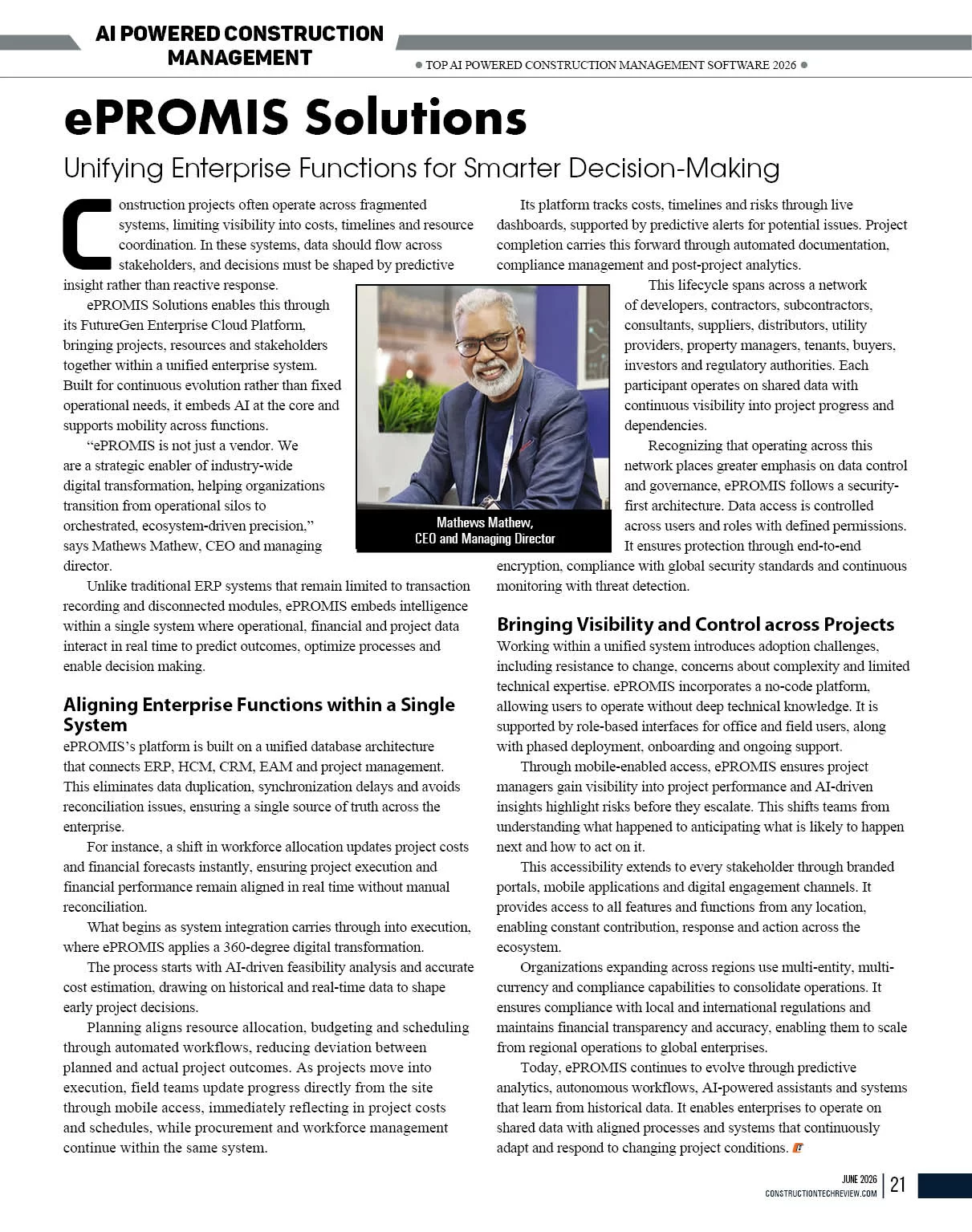
 Mathews Mathew, CEO and Managing Director
Construction projects often operate across fragmented systems, limiting visibility into costs, timelines and resource coordination. In these systems, data should flow across stakeholders, and decisions must be shaped by predictive insight rather than reactive response.
ePROMIS Solutions enables this through its FutureGen Enterprise Cloud Platform, bringing projects, resources and stakeholders together within a unified enterprise system. Built for continuous evolution rather than fixed operational needs, it embeds AI at the core and supports mobility across functions.
“ePROMIS is not just a vendor. We are a strategic enabler of industry-wide digital transformation, helping organizations transition from operational silos to orchestrated, ecosystem-driven precision,” says Mathews Mathew, CEO and managing director.
Unlike traditional ERP systems that remain limited to transaction recording and disconnected modules, ePROMIS embeds intelligence within a single system where operational, financial and project data interact in real time to predict outcomes, optimize processes and enable decision making.
Aligning Enterprise Functions within a Single System
How does a unified database architecture improve coordination across enterprise functions and projects?
ePROMIS’s platform is built on a unified database architecture that connects ERP, HCM, CRM, EAM and project management. This eliminates data duplication, synchronization delays and avoids reconciliation issues, ensuring a single source of truth across the enterprise.
For instance, a shift in workforce allocation updates project costs and financial forecasts instantly, ensuring project execution and financial performance remain aligned in real time without manual reconciliation.
What begins as system integration carries through into execution, where ePROMIS applies a 360-degree digital transformation.
The process starts with AI-driven feasibility analysis and accurate cost estimation, drawing on historical and real-time data to shape early project decisions.
Planning aligns resource allocation, budgeting and scheduling through automated workflows, reducing deviation between planned and actual project outcomes. As projects move into execution, field teams update progress directly from the site through mobile access, immediately reflecting in project costs and schedules, while procurement and workforce management continue within the same system.
-
ePROMIS is not just a vendor. We are a strategic enabler of industry-wide digital transformation, helping organizations transition from operational silos to orchestrated, ecosystem-driven precision.
Its platform tracks costs, timelines and risks through live dashboards, supported by predictive alerts for potential issues. Project completion carries this forward through automated documentation, compliance management and post-project analytics.
This lifecycle spans across a network of developers, contractors, subcontractors, consultants, suppliers, distributors, utility providers, property managers, tenants, buyers, investors and regulatory authorities. Each participant operates on shared data with continuous visibility into project progress and dependencies.
Recognizing that operating across this network places greater emphasis on data control and governance, ePROMIS follows a security-first architecture. Data access is controlled across users and roles with defined permissions. It ensures protection through end-to-end encryption, compliance with global security standards and continuous monitoring with threat detection.
Bringing Visibility and Control across Projects
Why are adoption challenges important when implementing unified enterprise systems across organizations?
Working within a unified system introduces adoption challenges, including resistance to change, concerns about complexity and limited technical expertise. ePROMIS incorporates a no-code platform, allowing users to operate without deep technical knowledge. It is supported by role-based interfaces for office and field users, along with phased deployment, onboarding and ongoing support.
Through mobile-enabled access, ePROMIS ensures project managers gain visibility into project performance and AI-driven insights highlight risks before they escalate. This shifts teams from understanding what happened to anticipating what is likely to happen next and how to act on it.
In what way does platform accessibility support collaboration across stakeholders and geographic regions?
This accessibility extends to every stakeholder through branded portals, mobile applications and digital engagement channels. It provides access to all features and functions from any location, enabling constant contribution, response and action across the ecosystem.
Organizations expanding across regions use multi-entity, multi-currency and compliance capabilities to consolidate operations. It ensures compliance with local and international regulations and maintains financial transparency and accuracy, enabling them to scale from regional operations to global enterprises.
Today, ePROMIS continues to evolve through predictive analytics, autonomous workflows, AI-powered assistants and systems that learn from historical data. It enables enterprises to operate on shared data with aligned processes and systems that continuously adapt and respond to changing project conditions.
Advancing Decision Intelligence in Construction Management Software
Construction organizations are under growing pressure to coordinate complex projects across geographies, partners and regulatory environments while maintaining cost discipline and delivery certainty. Traditional systems that focus on recording transactions struggle to keep pace with this shift. The limitation is not a lack of data, but the inability to convert data into timely, forward-looking decisions. As projects scale and interdependencies increase, executives are placing greater emphasis on systems that can unify information flows, anticipate disruptions and guide action rather than simply document outcomes.
The most capable construction management platforms distinguish themselves through how they structure and govern data across the enterprise. Fragmented architectures often create delays between operational updates and financial visibility, leading to reactive management. In contrast, a shared data foundation allows workforce allocation, procurement activity and financial projections to reflect changes as they occur, reducing reconciliation effort and improving confidence in reporting. This level of coherence shapes how leadership teams evaluate risk, allocate capital and maintain project discipline. It also strengthens accountability, as every stakeholder works from the same version of project reality without conflicting interpretations.
Equally important is how software supports the full lifecycle of a construction project. From early feasibility assessments through planning, execution and closeout, decision-making must remain consistent and informed by both historical patterns and live inputs. Systems that embed predictive insight into scheduling, budgeting and resource planning allow organizations to address issues before they escalate. Real-time visibility from field operations, combined with structured workflows, enables project managers to move beyond retrospective analysis and focus on immediate course correction. The result is a shift toward continuous oversight rather than periodic review. This continuity ensures that the strategic intent set during planning is not diluted during execution.
Adoption remains a critical constraint. Many construction firms operate with limited technical depth at the project level, making ease of use and accessibility central to any successful implementation. Platforms that lower the barrier through intuitive interfaces, role-based access and incremental deployment tend to achieve stronger uptake. Mobile accessibility extends this advantage by allowing site teams to contribute data directly, reducing reliance on intermediaries and improving the timeliness of updates. This direct connection between field activity and enterprise systems is a defining characteristic of more advanced solutions.
Another defining factor is the ability to support organizations that operate across multiple jurisdictions. Construction firms expanding internationally must navigate varying compliance standards, currencies and reporting requirements. Systems that integrate these dimensions into a unified framework allow leadership to maintain oversight without fragmenting operations. This capability supports scalability and governance, ensuring that growth does not come at the expense of control.
Within this landscape, ePROMIS Solutions presents a model aligned with these expectations. It approaches construction management as an intelligence-driven environment, embedding predictive insight and automation into a single-database structure that connects finance, workforce management and project execution. This architecture removes reconciliation gaps and provides a consistent view of performance.
Its lifecycle coverage supports continuity in decision-making, while mobile access keeps field teams and external stakeholders engaged. By extending connectivity to contractors, suppliers and investors through integrated portals and applications, it creates a shared environment that supports coordinated action, making it a strong choice for managing complexity.
...Read more
AI Powered Construction Management Software Info
Q1
What makes ePROMIS Solutions distinctive in the AI powered construction management software market?
ePROMIS Solutions differentiates itself through AI powered construction management software built around a unified enterprise ecosystem rather than disconnected construction tools. Its ePROMIS FutureGen Enterprise Platform combines ERP, project management, workforce management, asset tracking and analytics within a single cloud-based environment. This integrated structure allows construction organizations to manage scheduling, financial controls, procurement and collaboration through one connected platform instead of relying on fragmented systems. The company also emphasizes mobility and real-time visibility, enabling project stakeholders to access live project information securely across smartphones, tablets and desktop devices.
Q2
How does ePROMIS Solutions help construction companies improve project oversight?
Real-time visibility is central to the company’s AI powered construction management software strategy. ePROMIS Solutions provides centralized dashboards, analytics and project monitoring capabilities that help organizations track schedules, budgets, workforce allocation and operational performance more efficiently. Its platform supports multi-entity and multi-stakeholder coordination, which is particularly valuable for firms managing projects across different locations or business divisions. Advanced automation and configurable workflows also reduce reliance on manual coordination, allowing teams to respond faster to changing project conditions and resource requirements.
Q3
Why is ePROMIS Solutions relevant for modern construction enterprises?
Construction organizations increasingly require connected systems capable of handling financial management, compliance, project execution and operational reporting together. ePROMIS Solutions addresses this demand through AI powered construction management software that unifies these functions inside a scalable cloud platform. The company’s software supports construction accounting, project controls, subcontractor management, equipment tracking and compliance oversight while maintaining centralized operational data. This connected approach helps firms reduce information silos and improve collaboration between field operations, finance teams and executive management.
Q4
How does ePROMIS Solutions use AI and automation within construction workflows?
Automation within the platform focuses on improving decision-making and reducing repetitive administrative tasks. ePROMIS Solutions integrates analytics, business intelligence and AI-supported forecasting capabilities into its AI powered construction management software to help organizations identify project risks, monitor performance trends and optimize resource utilization. The platform also supports intelligent workflow automation for approvals, reporting and operational coordination. Combined with cloud accessibility and mobile support, these capabilities help teams maintain more consistent communication and faster response times across active construction projects.
Q5
How does ePROMIS Solutions support scalability for growing construction businesses?
Scalability is a major component of the company’s AI powered construction management software architecture. ePROMIS Solutions designed its enterprise platform to support organizations ranging from smaller contractors to multinational construction firms operating across multiple regions. Multi-currency support, multilingual functionality and role-based access controls allow businesses to expand operations while maintaining centralized governance and compliance oversight. The modular structure also enables companies to adopt additional operational capabilities as business requirements evolve without replacing their existing platform infrastructure.
Q6
What operational value does ePROMIS Solutions deliver to construction teams?
Construction companies using ePROMIS Solutions benefit from improved coordination, stronger process standardization and greater operational visibility through its AI powered construction management software. Case studies referenced by the company describe improvements in resource utilization, proactive risk management and project delivery consistency after implementation. Centralized project management tools help teams monitor activities in real time while integrated analytics support more informed business decisions. By combining ERP functionality with construction-specific workflows, the platform helps organizations streamline operations, improve productivity and maintain tighter control over project execution.
| Share this Article: Tweet |
Company
ePROMIS Solutions
Management
Mathews Mathew, CEO and Managing Director
Description
ePROMIS Solutions delivers an enterprise platform that unifies project management, resources and stakeholders through a single database architecture, using AI, automation and mobility. It enables predictive decision-making, real-time visibility and coordinated execution across construction and connected industries.
Top
