
THANK YOU FOR SUBSCRIBING
× 
Construction Tech Review Weekly Brief
Be first to read the latest tech news, Industry Leader's Insights, and CIO interviews of medium and large enterprises exclusively from Construction Tech Review


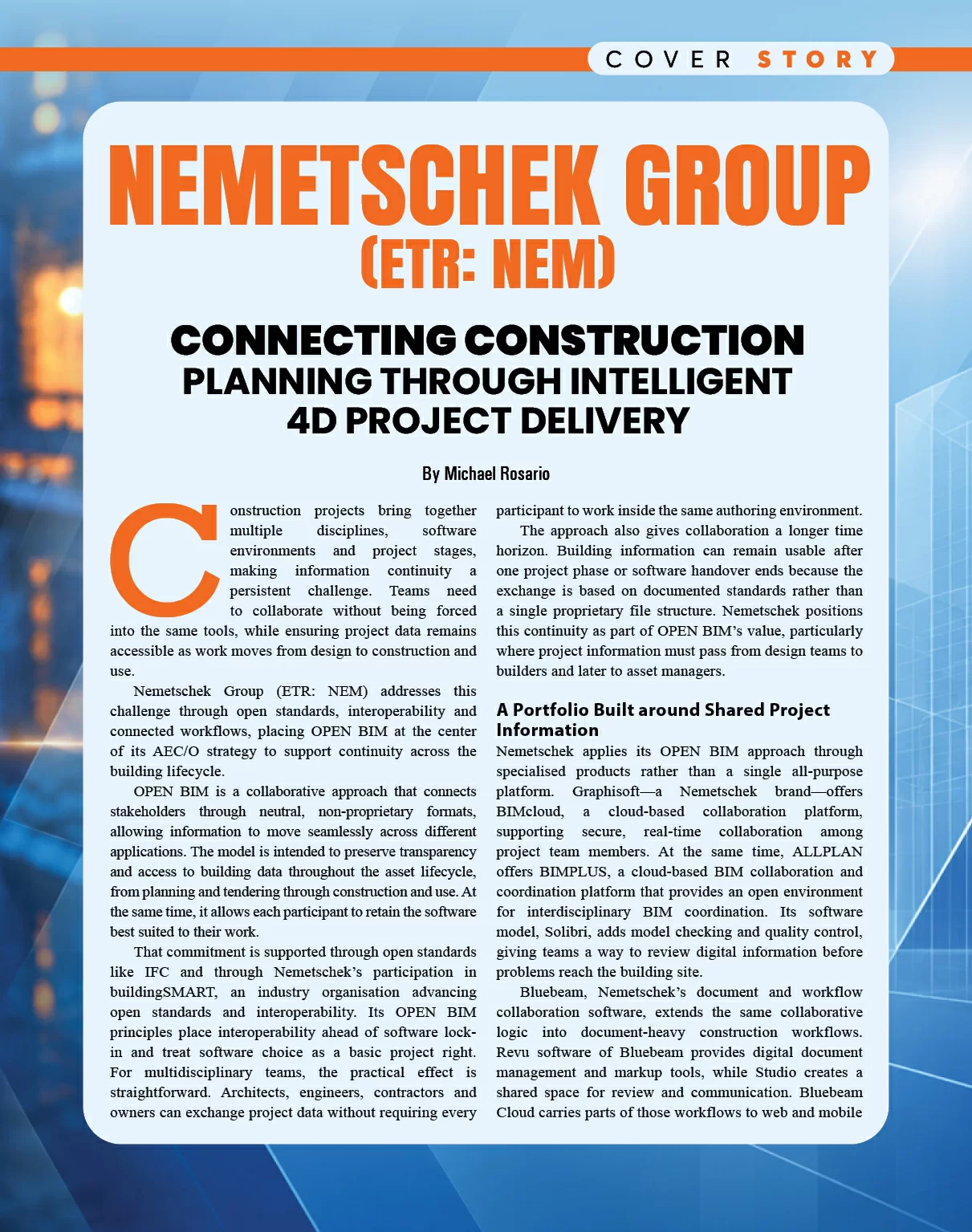
Construction projects bring together multiple disciplines, software environments and project stages, making information continuity a persistent challenge. Teams need to collaborate without being forced into the same tools, while ensuring project data remains accessible as work moves from design to construction and use.
Nemetschek Group (ETR: NEM) addresses this challenge through open standards, interoperability and connected workflows, placing OPEN BIM at the center of its AEC/O strategy to support continuity across the building lifecycle.
OPEN BIM is a collaborative approach that connects stakeholders through neutral, non-proprietary formats, allowing information to move seamlessly across different applications. The model is intended to preserve transparency and access to building data throughout the asset lifecycle, from planning and tendering through construction and use. At the same time, it allows each participant to retain the software best suited to their work.
That commitment is supported through open standards like IFC and through Nemetschek’s participation in buildingSMART, an industry organisation advancing open standards and interoperability. Its OPEN BIM principles place interoperability ahead of software lock-in and treat software choice as a basic project right. For multidisciplinary teams, the practical effect is straightforward. Architects, engineers, contractors and owners can exchange project data without requiring every participant to work inside the same authoring environment.
The approach also gives collaboration a longer time horizon. Building information can remain usable after one project phase or software handover ends because the exchange is based on documented standards rather than a single proprietary file structure. Nemetschek positions this continuity as part of OPEN BIM’s value, particularly where project information must pass from design teams to builders and later to asset managers.
A Portfolio Built around Shared Project Information
Nemetschek applies its OPEN BIM approach through specialised products rather than a single all-purpose platform. Graphisoft—a Nemetschek brand—offers BIMcloud, a cloud-based collaboration platform, supporting secure, real-time collaboration among project team members. At the same time, ALLPLAN offers BIMPLUS, a cloud-based BIM collaboration and coordination platform that provides an open environment for interdisciplinary BIM coordination. Its software model, Solibri, adds model checking and quality control, giving teams a way to review digital information before problems reach the building site.
Bluebeam, Nemetschek’s document and workflow collaboration software, extends the same collaborative logic into document-heavy construction workflows. Revu software of Bluebeam provides digital document management and markup tools, while Studio creates a shared space for review and communication. Bluebeam Cloud carries parts of those workflows to web and mobile use. Together, these tools help teams move comments, drawing changes and project records through a common digital process instead of relying on disconnected paper or static files.
The breadth of the portfolio is important because project participants rarely perform identical tasks. A designer may need BIM authoring, a coordinator may need model checking, and a contractor may rely on marked-up drawings on site. Nemetschek’s model allows those roles to use purpose-built applications while maintaining continuity through common data standards, cloud collaboration and connections among products.
Interoperability Extends beyond the Group
Nemetschek has also pushed interoperability beyond its brands. Its 2024 agreement with Autodesk opened mutual API and cloud access across relevant products. The arrangement connects platforms including dTwin, Bluebeam Cloud, BIMcloud and BIMPLUS with Autodesk industry clouds, allowing customers and developers to create data flows that cross company boundaries rather than stopping at the edge of one software ecosystem.
That principle is becoming more visible inside individual products. In 2026, Graphisoft announced a connection between its Archicad BIM software and Autodesk Forma. This enables the exchange of native design data and project information while allowing architects to continue working within Archicad. The integration reflects a broader choice-based strategy in which collaboration does not require teams to abandon familiar design environments simply because another project participant works elsewhere.
Nemetschek is also developing an open collaboration fabric for its design ecosystem. The initiative is intended to keep models, documents, issues and decisions synchronized across Graphisoft solutions and the wider Nemetschek portfolio. It supports widely used formats including IFC, BCF and RVT.
Workflow Gains Show Up in Project Delivery
The value of the model becomes clearer in project use. Assael Architecture, a London-based architectural practice, used Nemetschek’s Vectorworks Architect model and Solibri model checker on the Pontoon Dock development in London. Its process moved architectural and engineering IFC files through a scheduled two-week coordination cycle, combined discipline models for clash detection and issued federated-model reports before design meetings. The project became Assael’s first to reach BIM Level 2 collaboration.
Bluebeam provides another example of workflow change. Premier Mechanical, a Chicago-based commercial mechanical contractor, used Revu to replace paper-based processes across estimating and project delivery. Nemetschek saved 110,000 square feet of paper each year and eliminated about 1,000 hours annually that had been spent handling paper. Shop progress also became visible to stakeholders in real time, helping reduce rework and communication errors.
Cross-Brand Intelligence Extends the Model
Nemetschek’s group strategy is increasingly focused on making capabilities reusable across brands. Its AI and Data Innovation Hub is designed to pool technical expertise, promote cross-brand collaborations and scale developments across different segments. That structure supports the logic behind the company’s software portfolio. Knowledge developed in one product environment can inform capabilities elsewhere without forcing every brand into an identical interface or workflow.
The same direction appears in its current design strategy. Nemetschek is bringing key elements into a cloud-native platform that spans early feasibility, detailed BIM and lifecycle collaboration. Its broader technology approach draws on domain expertise and close integration with customer workflows to extend automation into previously manual processes, while keeping professional decision-making tied to the underlying project context.
This combination of open standards, specialized applications, external interoperability and reusable cross-brand technology gives Nemetschek a distinct position in collaboration software. Its recognition as the Top Collaboration and Workflow Efficiency Management Software in Europe 2026 reflects the approach built around practical project continuity, software choice and connected information. Adoption depends on whether those connections remain reliable in daily use, and the company has made that requirement central to how its portfolio evolves.
When Collaboration Must Cross Construction Software Boundaries
Complex construction programs rarely fail at collaboration because teams lack software. Friction appears when architects, engineers, contractors and owners work in different applications, exchange files at different stages and lose context as information crosses those boundaries. A collaboration platform, therefore has to do more than centralize documents. It must preserve usable project information while allowing specialist teams to keep the tools that suit their work. Locking every participant into one environment may simplify administration, but it can create migration costs and disrupt established workflows. Procurement should test how much coordination depends on everyone adopting the same application and what happens when an outside consultant does not.
Interoperability deserves close scrutiny because project information changes hands repeatedly. Neutral exchange formats and documented standards can reduce dependence on proprietary file structures, but support for those standards is only useful when models, comments, revisions and project records remain usable across applications. Buyers should examine how a system handles cross-platform data exchange and whether handoffs preserve enough context for downstream work. API access also matters where project teams rely on software from multiple vendors. A platform that connects only within its own product family can leave the same gaps at organizational boundaries that it was purchased to remove. Compatibility should be tested against the actual authoring and review tools already present across a project network.
Role-specific workflow support is another practical constraint. Designers, BIM coordinators, site teams and reviewers do not work from identical interfaces or information sets. Collaboration software should let each group perform its own task without forcing every participant into a generic workspace. Model checking, markup, document review and mobile access may sit in different applications, yet the underlying project information still needs to stay connected. Buyers should look closely at how issues move between tools and how revisions are recorded. Decision history should remain traceable to the source material that prompted each change, particularly when responsibility passes between disciplines.
Cloud access can widen participation, but governance around shared information is equally important. Real-time review is useful only when permissions and version control remain clear enough to support accountability. That becomes harder on programs where design teams, contractors, specialist consultants and asset stakeholders enter and leave at different stages. The system should support continuity beyond a single handoff and keep data accessible as a project crosses phase boundaries and later enters use. Procurement should test whether information remains reliable after a software change or a team transition. Long-lived access matters because project data often outlasts the application release or contractual phase in which it was created.
Nemetschek Group (ETR: NEM) addresses this problem through specialized applications connected by open standards rather than a single all-purpose platform. Its portfolio includes Graphisoft BIMcloud for cloud collaboration, ALLPLAN BIMPLUS for BIM coordination, Solibri for model checking and Bluebeam tools for document review and markup. Its OPEN BIM approach supports neutral data exchange through IFC and BCF without requiring every participant to adopt the same authoring environment. External connections, including Autodesk integrations, extend that approach across company boundaries. The portfolio gives project teams room to retain familiar applications while keeping shared information connected across handoffs. For buyers prioritizing interoperability and role-specific workflow continuity, Nemetschek merits serious consideration.
...Read more
Collaboration and Workflow Efficiency Management Software in Europe Info
Q1
What Is Collaboration and Workflow Efficiency Management Software?
Collaboration and Workflow Efficiency Management Software connects people, project information and work processes across different stages of a project. In architecture, engineering, construction and building operations, these tools can help teams exchange models, documents, comments and project records without requiring every participant to use the same application. Collaboration and Workflow Efficiency Management Software can also support continuity when information moves from design to construction and later building use. This can be especially useful when project teams need to keep information consistent across design, coordination, construction and later operational stages.
Q2
How Does Nemetschek Group Apply Collaboration and Workflow Efficiency Management Software?
Nemetschek Group applies Collaboration and Workflow Efficiency Management Software through an OPEN BIM approach built around interoperability and connected workflows. Its portfolio includes BIMcloud for cloud-based collaboration, BIMPLUS for BIM coordination, Solibri for model checking and quality control, and Bluebeam tools for document and workflow collaboration. These applications support different project roles while allowing information to move through connected processes.
Q3
What Capabilities Matter in These Collaboration And Workflow Tools?
Useful Collaboration and Workflow Efficiency Management Software needs to handle more than communication. Model coordination, document management, issue sharing, quality checks, cloud access and support for open data standards can affect how well project information moves between teams. Compatibility also matters when participants work in different software environments. A system that supports formats such as IFC and BCF can help teams exchange project information while retaining their preferred tools. This approach can reduce the need to recreate information when a project moves between applications or disciplines.
Q4
How Can This Software Reduce Project Workflow Friction?
Collaboration and Workflow Efficiency Management Software can reduce workflow friction by replacing disconnected files and manual exchanges with shared digital processes. Cloud collaboration can keep project information available to team members, while model checking and coordinated reviews can help identify issues before they reach later project stages. For construction teams, document markup and shared review spaces can also make drawing changes, comments and project records easier to track.
Q5
How Does Nemetschek Group Support Interoperability Across Project Environments?
Nemetschek Group supports Collaboration and Workflow Efficiency Management Software through connections that extend beyond its own product portfolio. Its 2024 agreement with Autodesk opened mutual API and cloud access across relevant products, including dTwin, Bluebeam Cloud, BIMcloud and BIMPLUS. In 2026, Graphisoft also announced a connection between Archicad and Autodesk Forma. These integrations allow project information to move across software environments while users continue working in familiar applications.
Q6
What Should Organizations Consider When Evaluating These Software Platforms?
Organizations evaluating Collaboration and Workflow Efficiency Management Software can consider interoperability, workflow coverage, information continuity and the ability to support different project roles. Open standards can help preserve access to project data beyond a single software environment, while cloud-based tools can support shared work across locations. Quality control and model checking are also relevant where project information must be reviewed before construction or handover. The right fit depends on the project processes, applications and information exchanges that need to work together.
| Share this Article: Tweet |
Company
Nemetschek Group (ETR: NEM)
Management
Yves Padrines, CEO
Description
Nemetschek Group develops software for architecture, engineering, construction and building operations, with an OPEN BIM approach that supports interoperable workflows. Its portfolio connects design, coordination, document management and collaboration tools, helping AEC/O teams exchange project information across software environments efficiently.
Top
